One significant consideration is oil temperature. After all, the oil must be warm enough to circulate freely and lubricate moving parts while not being so hot it boils off or loses viscosity.
The answer to the "When is the engine warm enough?" will always be a compromise between "When the oil is warm enough to circulate and splash over moving parts" and the stress applied by running the engine on the ground waiting for the oil to get warm.
The Lycoming O-145 Operator manual has this bit of advice:
GROUND RUNNING and Warm-Up-- The LYCOMING O-145-B2 engine is an air pressure cooled engine that depends on the forward speed of the airplane o maintain proper cooling. Therefore, particular care is necessary when operating this engine on the ground.
Avoid prolonged idling at low RPM as this practice may result in fouled spark plugs.
Limit ground running to 4 minutes in cold weather and ato 2 minutes at temperatures above 70 F
Note-- Engine is warm enough for takeoff when the throttle can be opened without back-firing or skipping of the engine.
"4 minutes" is not enough time (it takes me that long to taxi form my hangar to the end of 28), so I use 5 minutes from startup above 60 F, 10 minutes (or so) when it's below 60 F. Of course my engine is starting with an ambient temperature of at least 50 F since I use an Aerotherm engine heater set for 55 F.
Aluminum tape over oil pan blast hole
I use Phillips 25W-60 XC Aviation oil year round. I also put aluminum tape over the oil pan blast hole in winter.
This seems to result in the best combination of oil heating, engine operation, and overall happiness.
I planned -- hoped, really -- to fly an hour or so this morning before I drove to Exton. The forecast looked promising despite strong winds at 3,000. I review the local TAFs (KMDT, KLNS, KRDG) but always apply cautious doubt to visibility and wind forecasts, as the prog chart and winds aloft provide a better idea of what will be happening on the ground 12 or 24 hours from now.
So after dinner I drove out to Smoketown, set up the Aerotherm heater, shoveled the dusting of snow away from the front of the hangar, and did a preflight check of the engine and airframe before locking up.
All this tells me it won't be ideal flying weather for the Chief. The narrow temp/dewpoint spread tells me fog is likely, or at least the high probability of carb ice, especially early in the climb out before the engine heat has warmed the oil pan.
The varying wind directions and strength across so small and area tells me the air will be rough early, making flying a lightly-wing-loaded A/C like the Chief a real chore.
Couple this with pavement-only landing (the turf is covered in 1/2 of snow) and it just won't be much fun. So I scrubbed this morning's flight and plan on trying again tomorrow.
I accomplished some maintenance Saturday that took longer than expected. I didn't have time to fly once I was done so decided to do the test
flight this morning. Winds were calm or light (260 @ 3 at KLNS) and the air was cold (32 F) though hazy.
Smoketown Airport from 1500' AGL (looking towards runway 28)
Clear above, hazy below
Hazy sunshine
I arrived at 7:15 just after sunrise. The hangar doors were coated with a layer of frost. I pulled the airplane out, did a quick preflight, and went through the starting routine.
Silence.
After a few more throws I gave it more prime, spun the prop through a dozen times, and added a bit more throttle. It caught, then started sputtering. Another round of startup and finally she caught and after a few early stumbles started running smoothly.
Tiedown and chocks out, climb in, taxi to runway 28. The windscreen was now sporting a haze of frost but was still clear enough to see forward. I did an extra-long runup and everything checked out. Taxi to centerline, hold brakes, apply full power -- all good. Release and takeoff.
I stayed in the pattern, climbing to 2000' and enjoying the smooth air and million-mile view above the haze clinging to the cold ground.
I had limited time, so checked carb heat, then mags. Each side gave a 50 RPM drop at full power -- good. I really wanted to fly somewhere this beautiful day but had to get back down, get in the car, and drive to Exton. A passable landing on the pavement and then push back in, chock, close and lock, and drive away. She's good to go until next time!
Nice video taken by a friend last week. There was a strong westerly flow making it hard to do turns around a point!
Click the Full Screen view on the lower right to see more than a postage stamp! Also, turn up the sound to hear the roar of the mighty Lycoming O-145-B2!
This morning wasn't quite as perfect as forecast, but it was good enough -- calm winds, high overcast, decent visibility. I stopped by last night on the way home and checked the engine heater and everything was ready. A quick preflight, tie down, prime, throw -- soon the little Lycoming was chugging along happily at 1000 RPM.
I tosse din the chocks and tie down in case I landed somewhere this morning, climbed in, and taxied to 28. Winds were calm but I taxied to the uphill runway to have time to warm up the engine. The runup checked out.
Set up just right of the centerline, gradual but firm power, tail comes up, skip -- flying. We climb easily in the cold air and turn an early crosswind to avoid a flock of geese at about 800' AGL. Downwind, check oil pressure, temps, RPM -- all is a go. I overfly the field and head west.
Morning departure from Smoketown, PA (S37)
Climbing out from S37
Skies clear to the East
Smoketown from downwind for Runway 28
Endless farmland east of Lancaster
Lancaster, PA
Lancaster General Hospital
Clipper Stadium (with temporary ice skating rink in Right field)
Balloon launch near Park City mall
Route 283 in foreground, Mount Joy, PA behind
I climbed to 1500' and overfly downtown Lancaster. On the west side a crew is preparing a balloon for takeoff. I descend to 500' AGL and fly over farmland north of Landisville. Janet lets me know she's outside. I do a couple of orbits over the house and wave.
I headed north low and not-so-slow, enjoying the sensation of speed. It's smooth down low (unusual) and I'm out over the farmland west of Manheim. I think about flying to Keller Brothers and climb to clear the furnace hills but there's a slight change in the engine note - or was there? A quick check shows gauges good, RPM fine -- everything performing as expected.
Well, let's fly level and head back, just in case....
I leave the throttle set to 2450 RPM, trim for level, and call Lancaster Tower requesting transit of the Class D on my way back to Smoketown. I'm cleared through at 2,000. A minute later he asks if I can climb to 2,500...
"It'll take a while, but sure..." I reply.
Once clear of the Delta he thanks me for the climb and wishes me a good day. No need for a transponder, panel-mounted GPS, or fancy communication set -- the exchange accomplished by a 12 year old Sporty's SP-200 handheld transceiver hooked up to a $20 whip antenna.
The engine's running fine. I descend to 1500 and let it fly. Still good. I reduce power to idle, check carb heat -- still good.
Oh well, I have time. So I push the nose down and south towards the farmland east of Strasburg. I fly across the ridge that parallels route 741 and do some hedge-hopping across woods and fields.
Farmland south of Strasburg, PA
Looking north
Haze and a high overcast over Lancaster County
I turn back towards the airport, confident the engine is fine. I enter a left downwind, do a nice low approach 5' above the runway, and pull up for a zoom climb. The next approach is nice and slow and I touch down within 25' of the selected point (it's always past where you think you'll touch down!) I taxi back and takeof -- everything is still fine. Downwind, base, slip, final -- another delicate touchdown on the grass.
Back to the hangar to remove the cowling and do some cleanup and maintenance!
I don't know why this plane crashed -- the NTSB will provide a report soon enough. So the following is not speculation on the cause of this crash.
But the conditions yesterday caused me to think about wind, and its contribution in other crashes.
Too many airplane accidents are caused by the pilot's inadequate accommodation for wind. Sure, all private pilots do some crosswind takeoffs and landing. But the practical and knowledge exams are content with the wind's effects on those short phases of flight. After all, once we're airborne we're part of the moving mass of air and that's that, right?
Not always.
Wind and Terrain
Throughout much of the Midwest, Great Plains, Great Lakes region, and Atlantic coast, the wind is basically unimpeded by terrain. Most turbulence we experience in our GA singles in these areas is caused by mixing between the low lying, slow-moving air near the ground and the faster-moving flow above or by wind flow disturbed by objects on the ground (trees, buildings, small hills).
In the Mountain west, pilots learn to study and scrutinize the winds before launching. Many GA single fliers won't launch if winds exceed 25 knots, since the downflow on the lee side of a mountain may exceed the climb rate of the airplane.
But terrain in the East can impose significant changes to the wind's direction and velocity. The Alleghenies are just west of here and I've flown over them many times. When winds are 10-20 knots from the west it will likely be a rough ride down low.. The same speed from the east may induce severe turbulence. Southerly or northerly flows don't result in much trouble, as the winds flow along the ridges.
Wind and Airplanes
The day of my CFI Checkride I planned to fly an A36 Bonanza from Connellsville (KVVS) to Rostraver (KFWQ) a short flight I'd made many times before. The skies were overcast and the wind was strong.
Here's an extract from a post about that flight:
I arrived at VVS to find the winds from 150 at 22 G 37. The winds died down a bit as I tried to decide what to do (only gusting to 32 knots), but were
variable between 150-170. The wind sock seemed to favor 170, and after
thinking it over I realized if I took off on 14 I would be climbing into
all the turbulence off the mountains, and the sink rate might exceed my
climb rate.
So I opted to accept the 60 degree crosswind and take off from 23 and turn west as soon as possible.
The takeoff run was exciting -- I lined up on the left side to account
for any drift. The airplane wanted to weathervane left into the wind but
I worked hard at maintaining a track parallel to centerline. I reached
70 KIAS, held it on a bit longer, and popped up into the climb. The
stall horn beeped at me a few times as I reached Vy (96 KIAS).
The crab angle to maintain runway centerline was about 30 degrees. I
pitched and trimmed for 100 KIAS and left the gear down for stability.
The airplane was caught several times by some sharp gusts and tried to
roll but I was prepared and caught it and prevented the roll without
over-correcting.
About 1200' AGL I raised the gear and began a slow turn westward at
about 10 degree bank. If I banked more than that the winds rolling off
the ridge were threatening to roll me right over, so I kept it gentle as
I came around.
The turbulence on climb out would have to rated moderate to severe. At 3500' MSL I leveled off.
The turbulence was far less violent and the airplane was flying
normally.
I don't have any expertise in heavy TW airplanes such as the DC-3, Beech Staggerwing, or B-17. I have some experience in a Cessna 180, Cub, and TaylorCraft L-4. I now have significant time in an Aeronca Chief which is a very light high-wing tailwheel. The wing loading on this airplane is on the order of 12lbs/Sqfoot which means the lightest gusts will affect the wing.
In winds above 20 knots on the ground, takeoff and landing becomes too much like work. Winds which would only make me decided which runway to take in the Bonanza or C205 will keep me grounded if I have a choice. Sometimes I don't and I launch in gusty winds anyway. It's a bit of a wrestling match until I get to an altitude where the terrain eddies are no longer the main cause of turbulence.
When penetrating turbulence in the Chief I slow down to 70 and just guide the airplane back to wings level. It makes no sense to grab the airplane from a left wing drop when a right wing drop is coming anyway. I also allow for some altitude deviations. I don't have a VSI but I do have a fairly good altimeter which lets me know when I've gained or lost 50 feet.
Wind and Forecasts
Here's my usual sequence when planning to fly local, on the same day (I use a different process for IFR or long XC flights):
Day before flying: Check weather on http://aviationweather.gov/. First I look at the Prog Charts which will show fronts, boundaries, pressure gradients and areas of precipitation. I may end with the progs if it looks really good or really bad. For more information I look at winds aloft, then TAFS around the area I will be flying (Since my base is now S37, I use KRDG, KLNS, and KMDT. If all three are similar I have a greater confidence in the forecast. If not, I'm wary
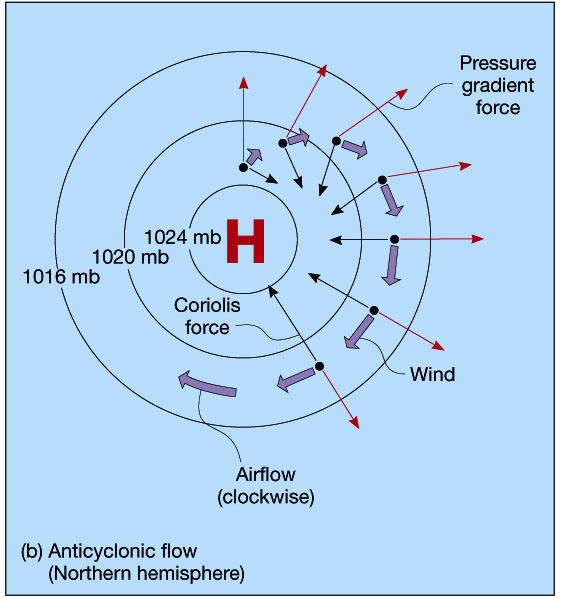
Pre-flight: I'm a morning flier. Winds are lighter, airports less busy, air cooler and less bumpy. In this part of Pennsylvania southerly flows suggest an impending change for the worse while northerly flows bring improvement. Westerlies are usually sign of at least 24 hours of good flying.
All this relates to the cyclonic flow of High Pressure systems. Good discussion here:
Cyclonic flow of High pressure system
I also check the FAA's NOTAM site for NOTAMS that may affect the flight.
If I'm going to fly cross country I call Flight service on the way to the airport. This call confirms what I know, but is an "official" weather brief and worth a second opinion if there is any ambiguity. If I'm going out and back ont he same day I'll get a standard brief for departure and then an outlook for return.
Satisfied that the weather is VFR and flyable, I pull out the Chief and preflight and start.
Wind and Observations
Smoketown doesn't have an ASOS/AWOS, sSo we listen to the Lancaster Airport ASOS on 125.675. I usually call it on the way in (717) 569-886. That's all fine, but what I care about just before launch is what the wind is actually doing. This is where you almost have to forget about what you heard and replace it with what you can see and feel. If LNS ASOS reported "winds 090 at 5" I'll keep that in mind as I taxi out. But once I can see the windsocks (there are two at S37) I forget about the report. It's not unusual for Lancaster to report winds that are opposite of what's happening on the ground 5 miles away in Smoketown.
This ability to distrust is critical. Too often pilots press on to a specific runway because of what they heard, what what is actually happening is different. This may not be a problem on takeoff, but in a lightweight taildragger landing with a tailwind could result in significant heartache and expense.
How can you know what the wind is actually doing?
Look at the windsocks
Look at flags
Observe the smoke or vapor from
smokestacks. The larger ones will tell you what the wind is doing for a thousand feet up (if it goes straight up then bends 90 degrees in one direction, you know there is an inversion, with stable air below and a strong flow above).
Look at ripples on a pond, lake, river
Note the
wind correction needed to maintain runway centerline and downwind, or fly along a road for a couple of miles.
The same is true of winds at altitude. It's also not unusual for the winds to be blowing hard from the west or south 800' AGL while it's calm or light and variable on the ground. Ignoring this causes all sorts of problems. One night flying out of Connellsville (KVVS) I learned this lesson the hard way:
"This evening the rather light winds were being reported as variable (all
over, actually) by the AWOS. But what was really happening was that a
very strong wind was blowing from the southeast very close to the ridge
altitude (approximately 2500' MSL), and then rolling off the ridge line.
So what VVS AWOS was sensing and reporting were the swirling eddie
undercurrents (thus the generally west winds). The A36 is usually a very
stable airplane, but in these conditions it was taking full control
deflection to remain upright. I apologized to the passengers and told
them we were heading back." (rest of the story here)
The most deadly is the southwest or southerly flow for a pilot landing on a westerly runway (28 at Smoketown, for example).
So our pilot is flying along on base, ignoring the wind pushing him towards the runway. As he's abeam the numbers he sets up landing configuration and speed reduction.
A quick glance backward confirms the runway is at a 45 degree ange behind -- well, more than 45 -- ok, better turn...
So we throw in a normal 30 degree bank turn and then level off, look off the left wing -- Hey! I'm almost past the runway! And high, too. Hmmm..
Base to final turn (from the Airplane Flying Handbook)
So we need to get turned on runway heading right away! So the pilot banks the airplane over30 degrees. But he's configured for landing and slow now. He adds flaps: We're obviously high...
I'm gonna overshoot, he thinks, but he remembers being told not to exceed 30 degree banks in the pattern. But that rudder can slew the nose around towards the runway...
At the same time the airplane gets jostled about in the turbulent boundary layer between the strong southerly flow at 700' AGL and the calm, cooler air below.
So we're slow, banked, in a skid, and the airflow gets disturbed by a sudden, strong gust. The pilot instinctively pulls back and turns opposite to pick up the dropped wing...
A month later the NTSB narrative concludes the cause was "The pilot's failure to maintain adequate airspeed while maneuvering, which resulted in an aerodynamic stall."
So how do we prevent this? First, know the winds, at the surface and at altitude. Winds aloft at 12,000 may be of no interest to you in a Cessna 152, but winds at 1200' better be. The lowest winds aloft report and forecast is 3,000. So it's up to us flying down low to understand what the wind is actually doing by how our airplane is affected. This doesn't take long and can be assessed in the pattern. If you need to crab right to maintain a track parallel to Runway 27 you know there's a southerly flow.
This is why sloppy flying is so dangerous. If you don't maintain a heading you don't know what the winds are doing. If you don't know what the winds are doing at pattern altitude you can get into the situation just described.
A reconstruction of an fatal Cirrus accident in 2008 by AvWeb:
The most dangerous pilot is the one who gets away with ignorance for a while. Eventually it will catch up, and sadly too many times passengers are involved.
Wind and Pilots
Not every pilot needs to fly in surface winds above 20 knots. But every pilot should be able to handle 20 knots, even if all you do is cruise around the pattern on calm Saturday mornings. You need to keep your skills up. Weather changes, and there will come a day when you fly to a nearby airport diner, finish lunch, and find that the winds forecast to be light and variable all day are now 20 gusting to 26.
Some pilots fight turbulence every bump with gritty determination. Don't. This usually makes it worse. better to let the stable airplane restore itself, or simply nudge it back if it goes too far. This is flying with a light touch, and is enabled by god trimming technique.
Take-Aways
Wind is dynamic, observations are snapshots in time. Once you're on final forget to windsock and do whatever it takes to keep the airplane aligned with the runway -- unless you have a reason to align some other way. In that case, make the airplane go where it needs to go.
Expect a reduction in crab angle as you descend.
Hand on the throttle all the way down final through touchdown and rollout. Use power to manage altitude, pitch to maintain airspeed (Cranky CFI Note: debate all you want about this, but on final this is simple, correct, and makes sense)
Release the death grip in turbulence. You're fighting the airplane and making it worse.
A recent fatal accident and a dumb incident has folks discussing the dangers of hand propping. There's evidence the fatal in San Diego was not a hand propping accident, but we'll wait for the NTSB to provide a narrative.
Still, any accident should remind us of the dangers inherent in aviation. Since most GA airplanes have starters, hand propping is considered a vestige of the old, reckless days.
There is no FAA requirement to learn hand propping, thus few pilots are exposed to the procedure. It should not be required as many pilots fly successfully for years without ever being exposed to hand propping.
But, as in most thing in aviation, it doesn't hurt to know more.
Who
Some will argue that Federal regulations require two pilots or at least two people. This is incorrect. There is no regulation prohibiting hand propping or requiring two people (or certificated pilots). This confusion arises from airport word-of-mouth and handed down "wisdom." It may also arise from reading The Airplane Flying Handbook has this section in Chapter 2:
HAND PROPPING
Even though most airplanes are equipped with electric starters, it is helpful if a pilot is familiar with the procedures and dangers involved in starting an engine by turning the propeller by hand (hand propping). Due to the associated hazards, this method of starting should be used only when absolutely necessary and when proper precautions have been taken.
An engine should not be hand propped unless two people, both familiar with the airplane and hand propping techniques, are available to perform the procedure. The person pulling the propeller blades through directs all activity and is in charge of the procedure. The other person, thoroughly familiar with the controls, must be seated in the airplane with the brakes set. As an additional precaution, chocks may be placed in front of the main wheels. If this is not feasible, the airplane’s tail may be securely tied. Never allow a person unfamiliar with the controls to occupy the pilot’s seat when hand propping. The procedure should never be attempted alone.
This is excellent advice, but it's not regulation. This is good, otherwise thousands of airplanes would be grounded or thousands of pilots would routinely break the law.
One can argue that it may be less safe to have two people doing the procedure, given the possibility of miscommunication. If you are doing it as a team, the person doing the propping is in charge, end of story. But this post is about solo propping. I'll leave the team method for another post.
What
Only certain airplanes should be hand started. These include the low-compression taildraggers of yesteryear: Cubs, Champs, Chiefs, Taylorcraft, etc. The prop is in the right position, there is no starter, there is (usually) a single impulse mag (which converts slow RPM movement to high RPM winding to produce a spark as it also retards the firing point), and a two bladed-prop (which provides a gap between prop being pushed and the next blade).
WARNING: High compression nosewheel airplanes are not good candidates for hand propping. Sure, ole lefty has done a million of 'em. You're not Lefty. Get a jump or get a preheat or get it fixed.
Now that we've narrowed down the airplanes we will hand start, we must consider the terrain, possess and use chocks and an adequate tiedown.
Terrain
Make sure the airplane is level and the ground in front of the prop is clear of gravel, ice, slick grass -- whatever. More than once I've gotten everything in place to find I was standing on dew-covered grass. Undo the tiedown, remove the chocks, and push it somewhere dry or at least not slick.
Chocks
Put chocks in front of the wheels. I use a set tied together with nylon rope so I can pull them out from the pilot side.I don't place chocks behind the wheels, since I'm on level ground.
Tiedown
I tie the tail down and attach it to something planted or heavy (I've used the hitch of My F-150 as a tiedown). A dog tie-out is not an adequate tiedown. Even my ancient 65-HP Chief will pull one of those screw-in deals out at takeoff power. The tiedown doesn't need to be tight -- the rope is a safety stop should the chocks not work. Be sure the rope is at least 1200 lbs of break strength (for a small 65-85 HP engine). When travelling I have pushed back to a fence post for a tiedown.
When
Only after the airplane is level, chocks are in place, tail is tied down, and the surface is clear and provides good footing do I begin the next phase of the starting procedure. I should emphasize here that fuel is off and mags are off while I'm pushing the airplane into position.
How
Solo starting procedure for the Chief:
WARNING: Always treat the prop as HOT -- that the slightest touch can start it.
Check inside of cockpit: Mags OFF, Fuel OFF, seatbelt out of the way, nothing on the floor.
Walk around strut and stand directly in front of nose within comfortable arm's length (leaning forward is worse than being "too close").
Grab prop near the hub and attempt to move the airplane. It should move back, but stop when it comes forward.
Walk around outside of strut and reach in to turn fuel on, give 4 shots of prime (number of shots may vary).
Check Mags OFF, Fuel ON
Walk around strut and stand directly in front of nose within comfortable arm's length. Check that chocks hold as in step 1.
Step once sideways to left. Reach for prop and without curling fingers around prop rotate prop through six revolutions (this primes the engine and is the procedure called for in the Lycoming O-145-B2 Engine Operator Manual).
Walk around strut, check primer IN, Fuel ON, Mags ON (left is usual impulse coupling), throttle in 1/2".
Walk around strut and stand directly in front of nose within comfortable arm's length. Check that chocks hold as in step 1.
Step once sideways to left. Reach for prop and without curling fingers around prop push prop down and away. This doesn't need to be forced as the impulse coupling are doing the work.
If engine starts, step back, then walk around strut (keeping and eye on the airplane for movement) and reach inside and adjust throttle for smooth idling (800-1000 RPM is recommended Idling speed on startup).
Once engine warms, reduce throttle to low idle (600 RPM) and walk to back and release tail tie down.
Return to cockpit and rev to 800-1000 RPM (low RPM does not provide sufficient oil splash, thus we want to limit the time running at low RPM and resume 800-1000 RPM to keep the oil moving).
Reduce RPM to low idle, lean forward and pull chock rope to release chocks. If they do not release hold onto strut to get better angle. If they cannot be removed then shut down and start all over again with chocks in better position to release (it happens).
This seems like an awfully long and involved procedure. But with practice it's basically automatic and takes all of five minutes. The key is to be consistent, check that the chocks are holding, always tie down, and always treat the prop as hot.
After a while hand propping becomes as normal as every other part of aviating. Just keep the requisite respect and safe procedure to be able to continue!
Yesterday I flew in perfect morning skies (more here)
Last night I checked weather and winds were forecast to be 15 gusting to 20. I woke at 6 Am and checked and winds were 260 @ 8 knots. I dressed, hopped in the car, and drove east to commit aviation before Church at 1015.
The hangar doors were rattling a bit but the winds were straight down the runway. I started, let it warm up, taxied onto 28, added power, and climbed out. There was a bit of turbulence until I reached 1200'. then it was smooth as glass.
I flew north then west, then back to Smoketown, for an hour's flight enjoying the clear skies and expansive views. A gentle touchdown on the grass ended a very nice flight.
A quiet morning at Smoketown
Climbing and heading northeast (towards New Holland)
Lancaster airport (KLNS) in the distance
A quarry north of Leola, PA
Lancaster County east of Route 222
Akron, PA
What's left of Speedwell Forge Lake (the dam needs repairs so the lake is being drained until the money is raised)
Bickerville, PA
Endless farmland
Clear and a million (Blue Mountain ridge is about 40 miles away)
Approaching Smoketown. Winds were so strong from the west I had to maintain a 220 heading to go south
Lancaster city
Smoketown airport from 1000' AGL. I usually land on the grass right after the white culvert to the left of 28


 Smoketown Airport from 1500' AGL (looking towards runway 28)