Saturday, November 19, 2011

Flying East!

Yesterday I delivered the 205 to Scranton/ Wilkes-Barre for the new owner to conduct a pre-buy inspection. I'm sure everything will be fine so that was likely my last flight in N8104Z.
N8104Z, 1964 Cessna 205 (IO-470) Ready to leave KVVS

I can't say I will miss this hangar -- the doors are insanely hard to open and close!

A little fuzzy -- it was about 20 degrees out, Janet was cold, and I was running late!


The confluence of the Susquehanna (North and West Branches)

Nice tailwind!

We stayed here Wednesday night!

He had to shuttle me back west, though, so I landed at KWAY and bid the bird farewell.
On the ramp at KWAY

Leaving KWAY (this is 1000' down the runway)

Nice climb (200' up halfway down the runway)
Then I headed over to John Strope's hangar where my airplane -- N24286 --  was sitting, looking nearly ready for flight.
Waiting to Fly

Original Panel and Gauges
 But first I had to put all the inspection plates, floorboards, and wing root fairings back in place. Re-assembling the whip antenna took the longest -- it takes three hands and you have to reach over the wing, so its not the easiest job. We also finished hooking up the air hoses and reset the cowling (it consists of four flexible aluminum pieces that have the be coaxed into position).

After two hours we pushed it out and started it up. It took a few throws but she finally came to life, running smooth and strong (relatively speaking, of course!) I took her around the pattern twice and all was in order. I went round on the first landing as I was a bit fast. I shouldn't have worried, though, as on the next landing I learned how soft the ground was! It was still fairly moist from rains earlier in the week.

We put her into a temporary hangar, hooked up the Deuce engine heater Bill had given me, and drove up to Washington, PA where Janet nd I spent the night at the local Hampton Inn.

We rose early this AM and headed back south on I-79 to Waynesburg. By the time I pulled the airplane out and had her loaded up and ready to fly it was 0750. I used my proven starting technique: 4 shots prime, rotate the prop 6 times (to evenly distribute fuel in all cylinders), mags hot, throw prop. On the second throw she started up. The cold-running chugga-chugga was replaced by an even putt-putt-putt. John said some of the valves were way out of adjustment. They'll all set to factory specs now.

I closed the hangar doors, untied and un-chocked, and climbed aboard. It was not quite as cold this morning as it had been yesterday -- clear evidence winds wee from the south. The high pressure that dominated our area was about to move east.

I checked flight controls while taxing to runway 27. The radio seemed to work but it was quiet. Runup had the normal 25 RPM drop on each mag and slight drop with carb heat. I checked the trim, announced that I was taking off to whoever might be listing, added throttle, and felt the airplane start rolling.

The tail came up and soon the earth was dropping away. I saw Janet watching from the car so I gave a little wing waggle. RPM indicated about 2300 -- as expected on takeoff. I flew past I-79, then began the left turn for downwind -- so far so good. A quick check in level flight indicated 2550 RPM and 85 MPH. Good, let's go.
New Salem, Fayette County, Pennsylvania
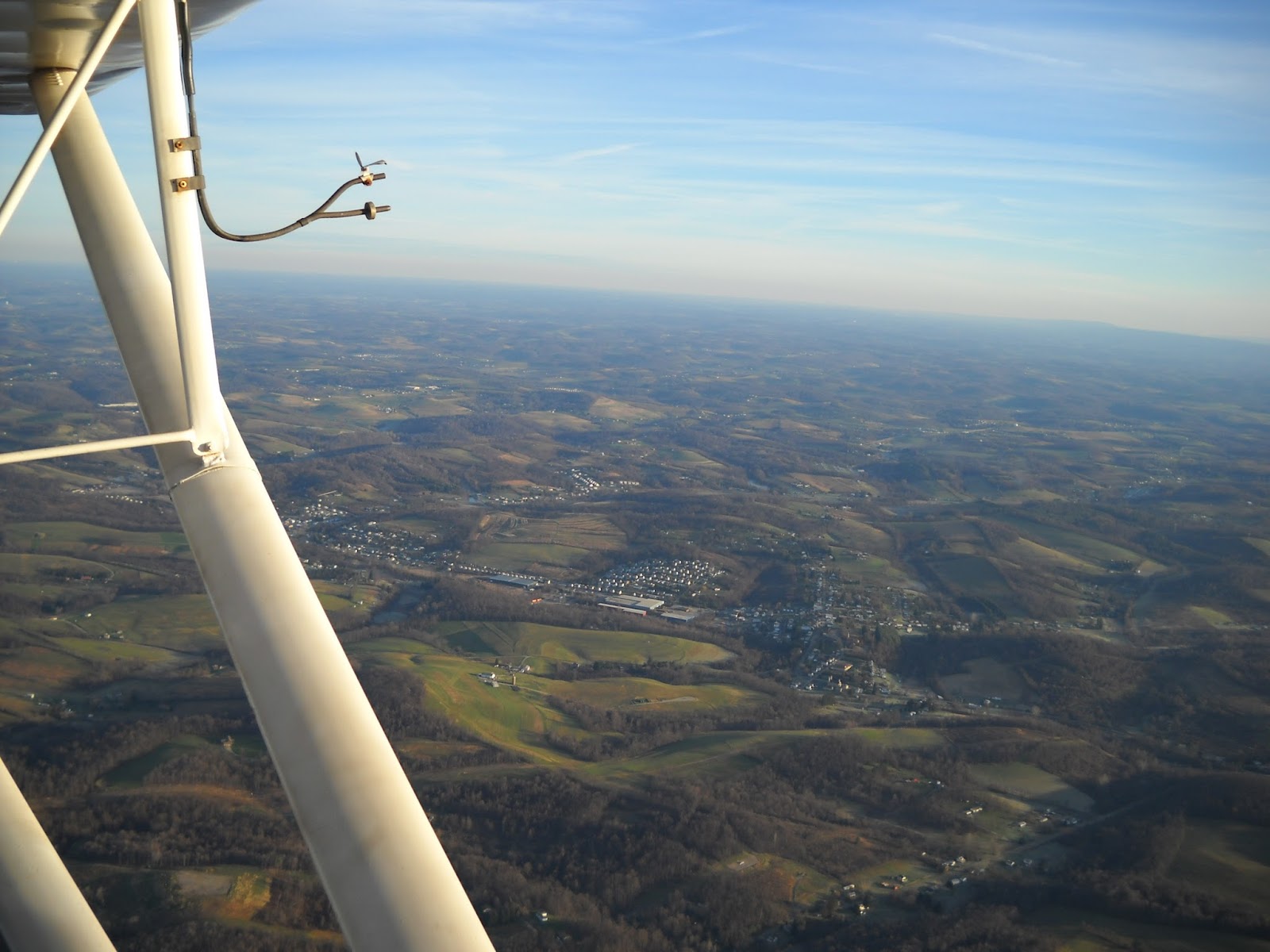
I set up an on-course heading of 100 degrees to correct for the southerly winds and maintained a steady climb at 65 MPH. Soon Fayette county was underneath. I spotted our house in New Salem just under the left wing. Soon Uniontown was ahead and I knew that the wind correction angle was too much. I headed towards the gap in the ridge near Connellsville and leveled off at 4000'. The engine was running steady and airspeed was indicating 82-84 MPH in level flight with 2450 RPM.
It's been 20 minutes, 57 seconds since startup. I took off 15 minutes ago and am still climbing to clear the ridges east of Connellsville.

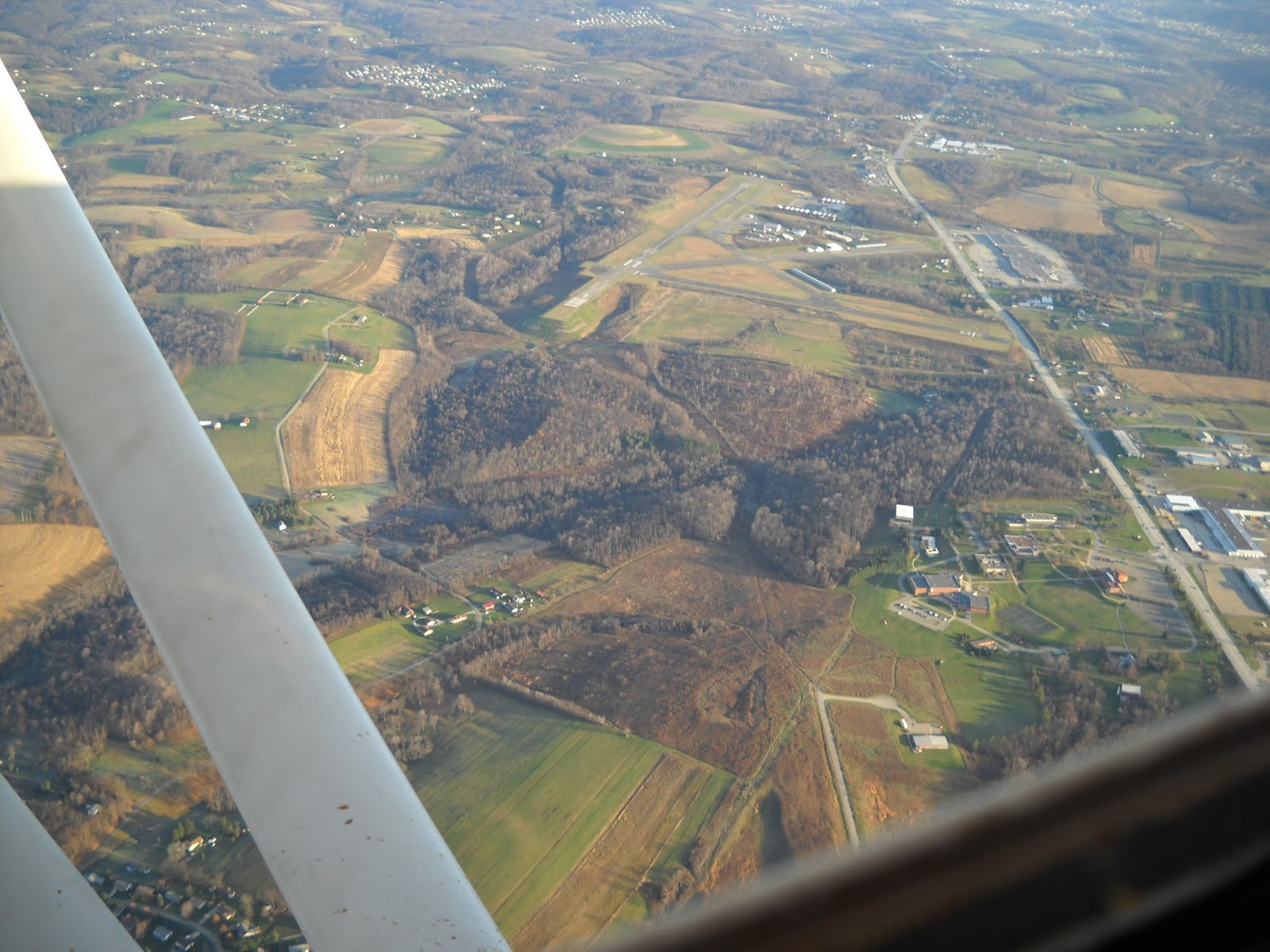
Connellsville Airport (KVVS) from 2100' AGL. Route 119 is just to the east
The Youghiogheny River runs through this gap in Laurel Ridge

The miles were ticking by and I was ahead of schedule. The winds were more westerly than forecast which predicted a southerly flow so I had to keep adjusting back to a 090 heading. Soon Somerset came in view. I listened to the AWOS and winds were 240 at 5, so I planned on landing on the pavement for the first time in many months.

I descended at a steady 90 MPH and entered the pattern at 3300'. I turned base to final and clearly the winds were significant up here. I added power to reach the field, and gently touched down on runway 25 and had to taxi a while to the fuel pump The lineman helped me out but there was more fuel in the tank than I realized and so it only took 4.15 gallons, with 1.5 flowing over the cowling. Oh well.

Ready to prop at Somerset County Airport. The aluminum tape below to prop helps reduce the cooling blast on the oil pan, allowing the engine to run warmer and produce more heat for the cabin!
The lineman said he couldn't give me a prop, so I pulled it over to the fence, tied the tail to a fence post, chocked the wheels, and primed it once. A quick flip and she was rumbling strong, but the throttle was a bit more advanced than I planned and I had to quickly reach in and throttle back -- she was ready to go!

Winds were 240 @ 10 now and after the long taxi down and a quick runup we were quickly airborne. I turned east not far past the airport edge and continued climbing. There were a couple of more high ridges to the east, the first with dozens of tall windmills. A steady climb at 70 MPH had me at 4500 feet in smooth air enjoying a significant tailwind. I turned on the Garmin 496 on the shelf behind me and it soon indicated a groundspeed of 100.1 knots!

But I didn't need the GPS today -- the air was spectacularly clear, with just a hint of haze.

The Flight 93 Memorial site, just east of Somerset.

Miles of valleys and ridges

Shawnee State park (Just west of Bedford, PA)

The mighty Lycoming O-145-b2, built in 1940, pumping out 65 horses (or so) at 2500 RPM....

Bedford, PA and the Pennsylvania Turnpike

Bedford Airport (KHMZ)

Forested Ridges east of Bedford, PA


2450 RPM, 83 MPH at 4200' MSL 29 minutes after startup at Somerset


The Sideling Hill Service area on the Pennsylvania Turnpike (I've stopped here far too many times...)

The easternmost tunnels on the Pennsylvania Turnpike

The last ridge, Blue Mountain

The Pennsylvania turnpike heading northeast towards Harrisburg. My route was directly east over York, PA
I maintained my heading and intercepted the turnpike a bit south of the planned point, so I followed it north and then turned to 110 degrees for a straight line home. I was going to descend to 2500' but the tailwinds were up here, so I stayed at 3500' until the Susquehanna river, just east of Three Mile island.

I could see Lancaster city in the distance and pointed the nose down a bit, maintaining a steady 90 MPH. That ended when I reached 2000' -- it was very rough, and I was working full time to keep the wings level. The winds were from 210 or so up here and rolling up over the hills along the north. I climbed back up to 3000 where it was still relatively smooth.

I switched to Smoketown CTAF and heard a few folks in the pattern. I lined up with Route 30 which runs east north of Lancaster and spotted the runway about 12 miles away.

I reduced power to 2000 RPM and trimmed nose down to establish a steady descent to pattern altitude. The air was unstable, but not as rough as near the river. I kept it in tight, did a slipping left hand turn and rolled out lined up for 28. I offset to the left a bit once I had the field made and aimed for a spot just past the ditch on the eastern edge of the field.I was a bit fast on final but getting tossed around pretty good until I levelled off about 5' above the grass. A smooth touchdown followed by a steady deceleration and meant I was home. Whew.

Red line is landing distance on the grass at S37 (500 feet)

I passed a couple of guys who watched me roll by the fuel pump, crossed the runway and taxied over to the new hangar and shut her down.

Centerville and Route 30 near Lancaster


City of Lancaster, Pennsylvania

Ready to be put away
See ya next time!
Smoketown Airport (S37), East Lampeter, PA

2.3 hours, 185 nautical miles traveled, 7 gallons of fuel (not bad!). The battery powering the handheld worked fine (I did a radio check 10 miles out from Smoketown and was Loud and Clear). I had the Garmin 496 on after I left Somerset and checked it to confirm position and groundspeed every 15 minutes or so and it used about 10% of its charge. I had a solar trickle charger on board but didn't need it.

This was my longest flight in the Chief and while I'm gad I did it, I'm not anxious to fly that far in this old bird again. It's cramped, noisy, and gets tossed around with the slightest turbulence. And it's a bit worrisome to fly over miles of desolate forest tracts with a single engine that has failed in flight once before.


Friday, November 11, 2011

Maybe??

Annual is supposed to be done this Monday (November 14th). If so, I will get out there the next day weather permits and fly it home!!!


Tuesday, November 8, 2011

Nice Evening to Fly

Had some time for a lesson late this afternoon. We had the airplane started by 415 and rolling by 420. The air was smooth and clear and the moon hung like a silver-rimmed jewel above the haze layer in a clear, sapphire sky. I had Rick practice steep turns and slow flight and speed control in level flight as I enjoyed the view.

It would be dark all too soon so I asked him to head to the airport. There's no GPS in this bird so it's pure terrain association. Fortunately Lancaster County has plenty of landmarks visible from 1500' up. After a bit of coaching we were downwind for runway 10.

Rick's getting the pattern and approach sequence. Landings are progressing but will take some practice. This is always a hurdle as it's rather unnatural to fly directly at the ground and then do big control movements while at slow flight. But then the moment comes when the light bulb clicks on and we all wonder, "Why did I ever think this was hard?"

No news today on the annual, which is not good news, as John was going to let me know his IA's schedule so we can have 24286 inspected so I can fly her home. This weather won't last -- of that I'm certain.

Saturday, November 5, 2011

Aeronca Air Ambulance Movie


This is a real hoot! Did anyone actually buy a Chief hoping to rescue fallen cyclists??

Friday, November 4, 2011

The Latest Update: November 4th, 2011

I flew the Cessna 205 back to its home in Connellsville, PA (KVVS) yesterday. I had to wait for the fog to clear before I took off from the lonely Donegal Springs Airport (N71) which is a mere 4 miles from our place in Mount Joy.

Donegal Springs looks like an airplane graveyard -- there are more airplane carcasses  falling apart amid weeds then there are flyable types. The hangars are in terrible shape -- several have doors permanently open with all sorts of rusting trash laying about. The runway is clear but the markings are gone. There has been no surface treatment in a very long time. I counted four airplanes that looked like they might be flyable. The rusting fuel pumps have a twin parked in front. Several aerostars site on flat tires around what looked like an FBO.

There are a few trailers next to the parking area that have a sign for the Donegal Springs Skydivers Club. I don't thin there's been a jump in a couple of decades.

I've flown in a couple of times and it's a nice enough strip -- clear approach either end, with the first half of runway 10 slightly downhill. Too bad there's nothing else to recommend the field except proximity.

Anyway, I bid adieu to this sad little airfield and climbed to 4500'. I requested advisories from Harrisburg Approach and stayed with them until I cleared Blue Mountain. They gave me a switch to Johnstown but I was too low and too far to make contact.I tried a couple of times and then just switched back to 1200 and descended to ridge skimming altitude.

Three Mile Island behind the strut, Harrisburg Airport (KMDT) in front
 I had a conference call at 1130 so I landed at Bedford (KHMZ), parked, and set up on the lone picnic table near the ramp. It was warm enough to conduct my meeting outside with cell phone and wifi provided by the FBO.

Three Mile Island, Susquehanna River


I launched an hour later and now the air was rougher. I followed the Turnpike for a while, then turned left at Somerset towards Connellsville. I've done the flight enough times to know a straight shot to Seven Springs then the next to the gap in the ridge formed by the Youghigheny would take me right to the airport. I was high (as I usually am to clear the ridge), slowed to 100 MPH, dropped 20 degrees of flaps, and slipped a bit to reach pattern altitude. I turned final and had a nice gentle landing on runway 23.
Endless Ridges seen from 4500' somewhere near Shippensburg, PA (Looking west)


Somerset, Pennsylvania and Pennsylvania Turnpike


I put the airplane away with Bill's help. We wiped off the bugs and loaded up and headed to Dairy Queen for some fast food.

It looks like he has a motivated buyer for 8104Z, and though I'm sad to see her go I'm happy that Bill can finally sell her. He hasn't flown much the past year and hangar fees, insurance, annuals, subscriptions and the rest can add up quickly.

I had to go pick up the trailer from U-haul so headed off to Hopwood where the process took four times longer than necessary. Finally I was able to hook up and roll out 45 minutes later. I drove straight to Waynesburg where I planned to do 1/2 the loading, park the trailer in the hangar, and finish loading Saturday. But there was no way to unhitch the trailer solo with all the weight in it, so I committed to loading the rest of the stored items boxes.

I checked in on John and saw my engine back on its mounts on 24286. He was looking for a few parts so he could finish. I didn't have them in the hangar (he later called to tell me he found them). The annual should be complete Sunday and I should be able to fly it home anytime after Monday, weather permitting.

He said some of the valve clearances were way out of spec. So with the valves adjusted to book spec and the new head gaskets preventing blow-by I should have a smoother running, more powerful engine -- and every additional horse is welcome when you only have 65 to start with!

We also replaced all the pushrod tube seals (which was the cause of the nuisance oil leak).So I'm looking forward to flying behind an engine that has essentially had a top overhaul completed.

The Chief Before I Bought It (Before and After)

The owner of john2031.com  took some pictures of N24286 in the hangar at Clarion Airport in 2003:


Notice the cowling -- yuck!

What the cowling looked like during re-finish:

I stripped it down completely and then did my best to reshape it a bit.


The nose piece also had to be stripped and reshaped:


The nearly finished product:

This picture also shows the new windscreen and the flat-black painted interior support tubes. I might paint the stripes back on.

Another before picture:

 And after. Notice the refinished prop, new tires, refurbished wheels, and shiny, clear windshield. This picture doesn't show that every inspection plate has been replaced and repainted.
I've since repainted the cowling with a creamy off-white to more closely match the rest of the airplane. More pictures to come after I get it back from this year's annual!

And the much-improved engine appearance. I removed all surface corrosion and repainted the engine with Lycoming Grey by Randolph Paints. I think the original was actually painted in black lacquer:
Lycoming O-145 in Smithsonian collection


Panel before restoration

Early November over Pennsylvania

Nice view of valley in between eastern ridges of the Alleghenies:


Tuesday, November 1, 2011

Power Source for Handheld Gadgets

My handheld radio setup worked well, but ate batteries. I averaged 10 transmissions before there wasn't enough power to push out (I could listen for a few hours).


So back to the web boards and Google. I found several posts about using a SLA battery as an alternate power source.

An SLA battery is a sealed battery most often used for backup power in emergency lighting. The package is reasonably small and dense, so it doesn't take much room in the tiny cockpit. (more about batteries here) I ordered a 12v from Radio Shack for $27.


The next challenge would be connecting the battery to the Handheld radio. After some research, I decided to use a 12v power adapter (like this). I'd make a female attachment from the battery, then plug the male end into the battery that way (and connect the radio power supply via the small plug).


I removed the alkaline battery pack from the radio, plugged everything in and -- success! I could hear transmissions on the handheld.

I zip tied the loose ends, applied Velcro to the bottom of the battery (so it would sit on the floor carpet) and carefully ran the power supply line along the glare shield.

I took a few test flights and am amazed. The radio performs as well as a panel mount and I have no real limit to total transmissions. I flew to Clarion and back through PIT Class Bravo and maintained contact with PIT Approach there and back with no problems.

My next project is attaching a small solar trickle charger to the battery to help maintain charge on longer flights. I should also be able to power a handheld GPS through this setup.

Handheld Radio Antenna Mount

Although I’d prefer to fly NORDO and use pilotage to get from A to Z, we live in more crowded, complicated times. That coupled with a hangar opening at a Class D airfield meant I needed 2 way communications on board my 1940 65-LA Chief (with original serial number O-145-B2 Lycoming engine).

I’d used a Sporty’s SP-200 handheld from the air before (once as a student pilot when I lost all electric in a C152 flying from KVVS to KLNS, and another time IFR in a 1947 V-tail Bonanza). I could hear them and they could hear me, so I figured it would work in the Chief. But I heard “Unreadable” more than I heard my tail number, even with an antenna extension stuck to the windscreen.

So after querying the email list and a few web boards I decided I’d install a whip antenna. I ordered the “Quickie Antenna Kit” (two BNC connectors, some RG-58 coaxial cable, torroids, copper tape), a 2'x2' 6061T6 .025 sheet of aluminum, and a straight VHF whip antenna from Aircraft Spruce.

I planned on installing the whip behind the baggage area. However, once I looked it over I realized the maze of tubing would severely attenuate the signal. I’d have to mount the antenna externally. This Chief is not a pristine show plane (by any stretch), so I choose function over form.

Materials

·      6’ Length RG-58 Coaxial cable

·      1 Male BNC Connector (to connect cable to radio antenna port)

·      1 ½” diameter ring terminal

·      Liquid tape

·      Solder

·      RTV Sealant

Tools

·      Adjustable wrench

·      Knife or diagonal wire cutters

·      Soldering iron

·      ½ “ metal drill bit

·      Drill

·      Screwdriver (to remove wing root fairing)

·      Multimeter (I bought mine at Ace hardware for $13)

The wing root faring material is too thin to support an antenna, so I reinforced it with a 2" x 6" strip of .025 aluminum as a doubler. I measured and re-measured, then grit my teeth as I drilled a ½” hole through the wing root fairing about 18” from the trailing edge. It took some work, but I finally had the doubler mounted in the gap between fuselage and wing, the wing fairing over that, and the antenna through a hole in each.
I fed the coaxial cable down in between the lower wing root fairing and the fuselage and then though a gap in the rear window seal.

On the antenna end, I stripped the coax and terminated both the center wire and the ground shielding (which in RG-58 is wire mesh, not foil as used on TV coax) with ring crimp-style terminals. I soldered to fill in the gap and ensure security of the terminal to each wire. I kept the two ends about 1 1/2" apart, and then insulated all remaining bare wire with Liquid Electrical Tape.

At the other end I tried to install on the screw-on BNC connector but no joy – it would not fasten no matter how many times I tried. I was running out of cable to cut and try again so I decided to get a better BNC connector from Radio Shack.

After a couple of trips to Radio Shack to get an RG-58 connector (be sure the connector is meant for RG-58. A RG-56 connector will not work), I completed the connection and took the airplane out on a test-taxi. Ground and Tower could hear me – as long as I was angled in certain ways towards the tower. In fact, I was unreadable when at the end of the taxiway for 18 –hardly a suitable situation.

After another round of questions on the board Bill Pancake and Peter Lapthorne both suggested it may be too close to the trailing edge. I decided to bite the bullet and drill another hole in the wing root fairing, this time close to top dead center. This reduced the length of the Coax run from 6' to 3', and provided a longer ground plane in each direction. Just for grins I stuck the 4’ length of copper tape that came with the quickie antenna kit to the underside of the doubler and the fairing. I checked and re-checked continuity and all was as expected.

I tightened everything up and sealed it with RTV. It ended up being a better solution since I was able to reduce the coax cable run to 3’. After doing complete multimeter checks, I rolled it out of the hangar and radio checked with ground and tower. All was loud and clear with no engine noise (I was still able to hear transmissions with squelch turned up quite a bit). I took off and headed north and could hear AWOS clearly 25 miles out. Then I transmitted to MGW tower and he heard loud and clear 15 miles out. In my headset it sounded as if I was in an airplane with a dedicated panel mount Comm system!

The standard Rayovac Alkaline AA batteries lasted for the dozen or so transmissions I made on the ground, in the air, and back on the ground after landing.  Direction of flight did not affect reception or transmission. I did not try to listen to 122.8, but my guess is I would hear the same amount of traffic as I would in an airplane with a panel mount.

I wish I’d kept a list of all those that provided advice and guidance, but I didn’t. Nevertheless, please accept my sincerest thanks!

Saturday, October 29, 2011

Home of the Reading Phillies!

Reading, Pennsylvania

Posted by Picasa

N75885

I have quite a few hours in this airplane -- it was a rental at (the now defunct) Flight Source in Morgantown, WV. I took my Instrument rating training in it. It wouldn't start the day of my practical test in Elkins, WV. The A&P hand propped it and off I flew. It barely started so I could take my instrument practical exam with my Designated Examiner (Don Judy of Elkins, WV). On the way back I had to file since it was so hazy and HOT.

I landed, parked the airplane, and drove home exhausted. Not long after I was home my instructor called and asked, "Did you notice anything wrong with the airplane?"

"No."

"Well, all the engine oil is in the cowling or on the ramp..."

I hadn't noticed anything unusual when I flew it, but when I realized it had no oil, that meant it had maybe 5 minutes of run time before the engine seized and 75885 would become a not-so-great glider.

I didn't rent it anymore after that.