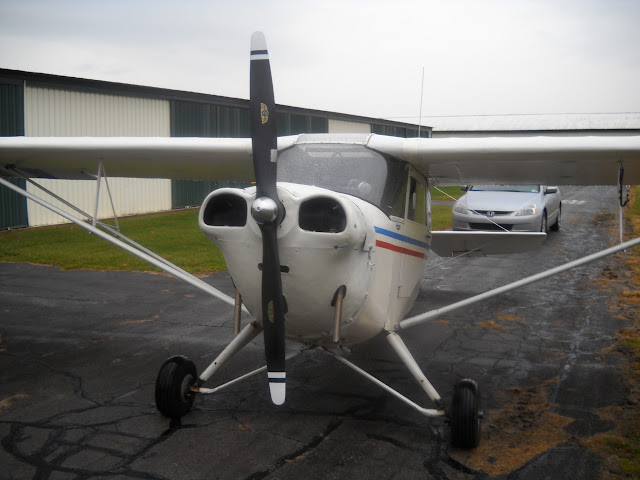
Sunday, December 5, 2010

First Winter Flight


Friday I checked the weather a few times and it looked like there would be a hole Saturday morning (the past week has been non-stop cold, gray, and light snow).

I stopped by the hangar Friday evening after work and hooked up the engine pre-heater (two 100w bulbs in trouble lights, two moving blankets, a carpet remnant, and an old army duffel bag wrapped around the cowling with a rope tied off on the prop). I give the bird a pat, take one last look, then turn off the lights and close the big sliding metal hangar door. The lock is cold as I jam it shut and twist the combination dial. I should replace this -- it's going to get water inside and freeze and then I'll be stuck. Note to self -- buy new lock.

I woke early Saturday and looked outside. While the sky was completely overcast, the haze beneath wasn't too bad. a check of the local METARS shows generally decent conditions with lowest reported visibility of 4 miles.

Janet has an all-day event at church today so I leave after she does and drive the truck to Waynesburg. The visibility is variable but VFR all the way. Of course, the airport is sitting in the thickest soup I've seen so far. Oh well -- it will clear.

Of course, the combo lock is frozen. I let the heat from my hands seep into the lock. Make another note -- get new lock.

I push the hangar doors open and light streams in the darkness. The bulbs are still on. I reach underneath the blanket expecting warmth but instead find cold aluminum. Ugh.

I go through my usual pre-flight steps, pull the airplane out into the diffused sunshine which doesn't seem to be coming from anywhere in particular but is slightly brighter than during the drive to the airport. Maybe the layer above is thinner than forecast? Yet there is no blue -- only white in the sky.

I close the doors, tie the tailspring to the truck's tow ring, place chocks in front of the mains, and look around to make sure I haven't forgotten anything.

It's cold, so I leave my hat and jacket on. 4 shots of prime, mags to OFF. Walk around front, push blades through 14 or so times. Walk back, mags ON, walk back, throw -- nothing.

There's are moments during some hand props when you wonder "Should I turn the mags off or move this into position by hand?"

I opt for the move with care. Throw the prop -- nothing.

OK....

Back to the cabin, mags off, another two shots of prime, 4 blades through.

Mags ON, walk back front, throw -- chug, chug.

A satisfying sound, but no guarantee. It's cold out and plugs that fire can get frosted over. I run to the cabin and push the throttle in a bit -- the engine stumbles, then coughs, more cylinders fire.

I ease the throttle in, then back out and the engine settles into its cold routine of heavy chugging at 800 RPM. It's OK -- the light bulbs haven't provided much heat and it's probably 25 degrees out. I stand next to the cabin and my legs freeze in the prop blast. I pull the throttle to idle and it settles at 500 RPM. The tail spring rope untied, I walk back up and reach for the chocks, connected by a 10' rope so I can pull both front mains from the pilots side. I saw someone else do it -- It works!

I'm planning a local flight so the chocks get tossed on the snow-coated grass.

I climb in and bump the throttle to 800 RPM and listen as the engine warms, chugging more regularly, evenly. Good.

I sit and listen to the engine, looking at the gauges. All is well, and now I can relax and enjoy it. All the preparation, planning, and work is done. The airplane is running, everything's been checked -- all that's left is to roll down the taxiway, then the runway, then plunge into the sky.


A blast of power and the airplane moves, the tail wheel straightens, and I check to either side for clearance. A few maneuvers to avoid puddles (I was by an A&P that water splashed up inside a wheel can freeze and lock it in place in the air -- making for a very interesting landing).

The air is a bit less hazy now and the sky seems brighter. Winds are minimal -- the wind sock moves inches, the flag hangs limp. I can takeoff either direction but will taxi to the end of 27 to give the engine more time to warm.

Control checks, trim set -- good. Killdeer walk along the runway -- why are they always on the runway? I taxi into position, straighten the tail wheel, and add power. The birds start to walk quickly to the south side of the runway. But not fast enough. I continue adding power and now the tail comes up. Killdeer fill the bottom of the windscreen -- com'on, birds.... this airplane may be small but that propeller is gonna hurt!

The birds take flight when I'm about 30' away. I feel the wings catching and the airplane is about to take flight as well. The prop bites into the cold air and the airplane is ready to fly. I hold it on a moment more, then release some back pressure. Rolling, rolling, then no sound from the wheels.

We're flying. Birds below now. Oil pressure still good, 2300 RPM -- OK. Pull back a bit and climb at 50, add some trim. I look to the right and pick out a spot to land if I lose power now. To the left and ahead is a parking lot studded with light poles and cars -- only if I have to. Still climbing, I glance at the airspeed and altimeter -- up to 300 feet now. I start a climbing left turn. hold the ball perfectly centered, feel the engine warming, RPM increasing.

Now the airport is under my left wing and the air is hazy, but smooth. I level off about 800 feet above the ground and announce a closed pattern, fly over the field, check all the gauges -- all is good.

Time to head east and fly over the house.

I climb to 2500' (1200' or so above the ground) and clear the river and the fog. Level the airspeed exceeds 80 MPH at 2500 RPM. Nice.

I pull on the carb heat from time to time -- it's an automatic precaution on these hazy days. Carb heat applied RPM drops slightly -- good. Off and RM increases -- good.

I have some fun flying low over New Salem and the house and a few familiar hills. I climb a bit then circle over Uniontown. I'd fly further east but the mountain is barely visible in the haze. I decide to fly along the new highway and reduce power and push the nose over, enjoying the lightness of zero g.
A few hunters are visible from here -- please don't take potshots at my airplane. I'm low enough one could reach.

I zoom over the highway and enjoy the sensation of speed low-level flight. The air is thick with haze, and I keep a close eye on the RPM. So far no carb ice -- good.

I'd fly longer but the cabin heat isn't working very well so I point the airplane along a mostly west until I see familiar landmarks. The water tower near the airport appears and soon I'll be landing. I delay things a bit by climbing and doing some slow flight, then steep turns, then a practice emergency turn back.

300' altitude loss from engine idle to 180 degree change of direction. Of course a turn-back requires more than 180 degrees and there is residual thrust in the idling prop. There is also no recognition delay. But it's fun to push the nose over from climb to glide at 60 while cranking in 60 degrees of bank.

Time for some slow flight fun -- throttle back to 2000 RPM, crank in some trim, and let the airplane settle in at 60 MPH. The engine purrs and it seems the airplane is happier at this speed. Maybe I should do this more often?

55 minutes have passed. It's time to land. I fly south of the field, then do a hard 180 to join mid-field left downwind. I'm at 500' above the ground, but 1000' AGL is to high and there's no one else flying. Touchdown point 45 degrees behind me, throttle to 1500 RPM, slow to 60, crank in full trim, turn left. Slip some and pull throttle to idle. There's the runway. I'll land 1/3rd down to save the endless taxiing. I crank in enough trim to maintain 55 and then pull back to keep it at 50. The ground comes up slowly and soon the wheels touch, all three nearly simultaneously, the tailwheel rumbling on the pavement. I prefer grass but it is frosted this morning.

I taxi to the hangar, shut down, pull the airplane back into the hangar, wipe off the oil, and lock up until next time.

Sunday, November 28, 2010

Neat!

I was doing some research on Tommy Smith this afternoon when I came across this link: http://www.flyinghigher.net/aeronca/N24286.html

The pictures should be familiar -- it's N24286 in the big hangar at the Clarion Airport!

Thursday, November 25, 2010

November Morning

Yesterday was the first test flight beyond the pattern in the Chief since the extensive maintenance done during the annual inspection this November. The forecast promised light winds and mostly clear skies with a low of 32 and a high of 48. I stopped by the hangar on the way home from work Tuesday evening and set up the 100w pre-heater, prepared the cabin, and made sure everything was ready to roll Wednesday morning.
Wednesday dawned as promised, but with some local fog and widespread cloud cover. I figured it was the typical November grey and would not interfere with the flight. The airport was clear enough and the windsock was hanging limp so the forecast was close. It took a few minutes to pull the airplane out, preflight, tie it down, and prime it, and the cold engine took a few tries before chugging to life. I saved myself some work by tying the tail to the truck’s frame. Once it was putt-putting smoothly I pushed the hangar doors closed (no easy task), locked up, untied, pulled chocks, and climbed in.
Control check, radio check, trim set, doors checked on the slow taxi down to the east end of the runway. Winds are calm but a 27 departure offers a few more emergency landing options immediately after takeoff.
Run up is fine, mags check, idle good – announce intentions on the radio, pull out into the pavement, and add power.
The tail came up quickly and the airplane was light on its feet in a couple of hundred feet. Airborne at 40, speed increases to 50. The ground falls away and the four cylinders provide a steady roar. RPM is climbing from 2200 to 2300 as the propeller unloads. I probably could have waited a bit longer for the engine to warm, but so far, so good.
Announce left closed traffic, turn and climb into the left downwind, check RPM, oil pressure, and level speed – all good. Announce leaving the pattern southbound, starts a shallow bank right and maintain a steady climb.
The air is heavy with a fine haze under a solid layer of cloud. I tune the radio to the Morgantown AWOS:  ceiling 2800 feet, winds calm. No problem – I won't be more than 1000 AGL. The terrain straight ahead and to the west is rather featureless – a series of hills and valleys with no discernable pattern. It’s hard to know what road or what tiny hamlet is below, so I look for the Morgantown and Shinnstown powerplant plumes.
If I keep Morgantown off the left wing and Shinnstown ahead and to the right a bit I’ll be on course. I check the compass from time to time and nudge it back to a heading of 190 degrees. I keep the radio on set to 121.15 and listen to Clarksburg Approach. It’s quiet.
From time to time I pull the carb heat on. RPM drops. I leave it on a minute then turn it off – RPM increases. Good, no ice, and the carb heat box was properly installed.
Time passes slowly and every little change in sound gets my attention. Yet the engine is running steady and the airspeed indicator is solid at 85 MPH at 2500 RPM. I’ve seen 85 from time to time but not usually solo in level flight. Nice! The scent of warmed paint and cooked oil wafts into the cabin. I push the heater in but all that happens is a flood of cold air. I know the engine is warm – hmmm. I’ll have to check that.
I check my cell phone. A text from Dave, my ride from the airport: “U inbound?” I reply, “Yep. 0818 arrival”
I take the time to look around. It’s hard to see much in the haze. It’s VFR and visibility is at least seven miles, but the early morning light is diffused and the grey sky gives everything a flat appearance.
Soon I can make out the outline of a lake, then houses – Fairmont should be straight ahead. There’s the river – and the interstate. I switch to 122.8, listen, then announce 5 miles out.
I can’t make out the airport yet but know where I am in relation to it. Soon I see the bend in the river and the long stretch of pavement. I don’t hear anyone on the radio and see no activity on or near the field. Winds are calm so I head straight in, reducing power, lifting the nose, cranking up the trim -- feeling and hearing the airplane change its gait from cruise to descent.
The ground slowly grows; the numbers on the runway remain centered in the windscreen as the world spreads out from those ever-expanding numbers. It’s an optical trick that is useful – the spot that doesn’t move is where you’re heading.
Check speed – 60 MPH. The river slips below me. Now the runway is made – if I lose power I’ll still make it to the airport. Power to idle; pull back a bit on the yoke: 50 MPH. I crank full nose up trim but that only maintains pitch to just below 60 – I try to keep a calibrated pull back on the yoke. The numbers flash beneath the wheels, and now the sensation of speed as the pavement slips beneath. Hold it off, hold it off, keep it straight while dozens of feet slip underneath. 50 MPH is probably too fast – I’ll have to try 45 next time.
There’s a slight rumble in the back yet I don’t feel the mains yet  -- then the mains touch. Keep it straight, no brakes, back pressure, ok -- good. The oleo gear gives the impression that the airplane is still flying when in fact the wheels are rolling, but there’s still a half of foot of travel downward as the pistons compress. I’ve been landing on grass all summer so the sounds and sensations of a pavement landing are noisy and foreign.
Release back pressure and let the airplane roll freely along the runway the remaining thousand feet to the parking spot. I pull the plane in to a tie-down marked with new ropes, switch off fuel, run up to 1500 RPM, get straight, pull back to 1000, the engine coughs, dies. Mags and radio off, unbuckle, unload, tie down, and walk over to the car.
“Good morning, Dave!”
“Hey, Dan…”
I check my watch – 0818.
Sometimes I guess well.
Chief ad from 1940

Tuesday, November 16, 2010

Yay!!!

FINALLY!!!


I took the morning off. Stopped by the airport last night after work and stayed until 1900. Put the wing root fairings back in, cleaned out the interior, and did a pre-flight check of everything else.

This morning arrived at 0830. John and I pulled it out on the ramp where we ran through the static tests -- everything ran as expected.

Put the cowling back on, bought 7.5 gallons of 100LL, and did another pre-flight.

Started up again (first throw with no prime -- before I had to prime every time) and taxied down to the end of 27. I had the airport to myself since it was a bit rainy with variable ceilings. It was VFR here now, though, so I did a radio check with Jim (the airport manager) and all was loud and clear (good -- I put the antenna back in correctly!)

Centerline, tailwheel straight, full power, oil pressure good, tail up, the earth falling away...

Nice.

I flew the pattern a few times, tried different power settings, hit 85 straight and level at 2500 RPM -- nice!

It was a bit bumpy 1000' AGL and the sky was dark to the south so I decided to land. Did one low pass then came around for the full stop. Nice touchdown and soon I was shut down in front of my hangar again -- it's been 5 weeks since I've been here!

Pictures: http://picasaweb.google.com/danmc61/N242862010Annual02

N24286 2010 Annual

Monday, November 15, 2010

Annual Completed!!

We will startup the engine after work and check everything. Should be able to move it to the hangar tonight!
A&P/ IA Accomplished
  • Remove and inspect prop, replace prop retaining bolts with AN-55 bolts IAW Lycoming O-145-B2 Maintenance Manual. Compression test (70-71 over 80 for each cylinder). Replaced pivot bolt left aileron hinge. Replaced induction tube connecting hoses. Replaced windscreen with LP Aero windshield.
Owner Performed Preventative Maintenance
  • Open boot cowling and clean. Remove venturi and clean.
  • Remove floorboards and clean and vacuum interior.
  • Remove glue and old carpet residue from floorboards.
  • Remove and replace all inspection covers and paint.
  • Remove all cowling pieces, strip old paint, prime, sand, and repaint Biscuit White
  • Refinish pilot and co-pilot yokes, panel and structural tubing in flat black.
  • Remove wing root panels to strip old paint, prime, sand, and repaint Biscuit White.
  • Inspect and replace missing screws on wing root-mounted handheld radio antenna.
  • Replace all exterior screws with aircraft-grade stainless steel screws.
  • Remove surface corrosion on engine with wire brush, repaint engine with Randolph Engineering Lycoming Grey engine enamel (P/N    ).
  • Remove and replace door gap insulation and hinge pins.
  • Refinish aluminum windscreen retention strips.
  • Remove corrosion from gas cap retention fingers, replace wire with 9” dualuminum (IAW Aeronca factory drawing     ), and refinish cork with varnish
  • Removed and cleaned and repainted carburetor and cabin heat boxes with high temperature gloss black paint, replaced missing screws.
  • Spark plugs cleaned, reinstalled
  • All SCAT tubes removed, cleaned, reinstalled.
  • Added original Aeronca logo decal on each side of vertical stab
  • Oil cap and dipstick painted yellow.
  • Firewall painted Lycoming gray.
  • Induction tubes cleaned, repainted with black high heat enamel.
  • All control pulleys lubricated.

Friday, November 12, 2010

Windshield is in!!

I stopped by the hangar on the way home and noticed the windshield is in! John and Darious worked it today and it looks good, but still has protective plastic on it, so won't see througg it until Saturday (I hope!)

Exhaust parts all cleaned and heat boxes re-secured and painted with high temp black.

I'm heading in tomorrow at 8 AM -- hopefully...?

Friday, November 5, 2010

Finally!

LP Aero called to say windshield is done! Pick up on Monday!
Plan this week:
  • Assist in Windshield installation, steam marine plywood backing to shape, drop off cowling, install doors using new hinge pins, install intake tubes, check plug and head torque
  • Install venturi, Install anti-chafing tape, install cowling, install propeller & spinner, glue headliner
  • Set up radio and battery cabling
  • Refasten headliner
  • Check plug torque
  • Check head bolt torque
  • Mount propeller
  • Install anti-chafe tape
  • Mount cowling 
  • Install Wing root fairings
  • Vacuum carpet, interior
  • Mount battery wires
  • Aeronca Decals
  • Lube primer, heat, carb heat, throttle controls 
  • Tailwheel lube

Wednesday, November 3, 2010

Still waiting...

Still no update on the replacement windshield from LP Aero.

Grrr....

Saturday, October 30, 2010

Nearly Complete!

Yesterday afternoon (I took a day off to take care of a dental appointment and some other personal business in the morning) I spent 5 hours in the maintenance hangar putting N24286 back together again. Every inspection plate (new and freshly painted to match) was replaced, the wing root strips (freshly painted) were put back in using stainless steel screws, and I took the time to hook up the handheld antenna a bit better (locknuts and washers). The antenna is solid and the top nut area is protected from moisture with a coating of RTV sealent.

The rudder assembly cover gave me some problems (it's not clear which way is up), but it's back on.

All accessible pulleys and cables were lubricated with LPS-2.

I put the fuel gauge assembly back on (the cap repainted, a new length of duraluminum 1/8" gauge wire, and a re-varnished cork bobber).

I put the floorboards back in with new screws (after one final clean up of the exposed fabric). The carpet cut out fit perfectly and lays nicely without moving. The carpet runs up and overlaps the seat fabric, helping seal out anything from sliding under the seat and back towards the tail.

The Sporty's Handheld radio was given a new strip of velcro and so was the mounting plate. It's straight and secure.

I finished painting the few spots I missed in the engine compartment. I checked the fit and look of the nosebowl -- it looks good. I found the right size screws to replace the rusty ones that were in there.

John tried to put the induction tubes back on but the hose collars were too short. New ones are on order.

I was going to put the anti-chafing seal on but we dedcided to remove the Venturi and clean it and see if we can get the bank indicator working. We'll see.

The skull-cap spinner looks good -- all corrosion removed and it looks nice and shiny. Not mirror-smooth since I'm not that patient.

I found replacement nails to use as door hinges. I may try the thin steel wire I tried as a fuel gauge replacement.

So far so good -- pictures to come once the windshield is in and the induction hoses installed.

Tuesday, October 26, 2010

Good News!

Full inspection of the airplane revealed no other issues -- some afternoon or this Saturday morning I can put all the covers back on, put in the new stainless screws, and snap on the refinished cowling!

The propeller looks great in matte black with white tips and a single 1" stripe. The spinner has been polished and is in fairly good shape -- though I'll look for a replacement.

The interior is looking very nice, the engine looks almost new, the new induction tubes will go on tomorrow (the old ones were dried out and probably leaking), and all the control pulleys have been lubed.

Saturday, October 23, 2010

Progress!

I spent most of today painting, painting, and painting!

The engine is finished and is looking very good. The firewall is nearly finished but will require a long-handled brush to finish.

Cylinders and engine block painted Lycoming Gray
All inspection covers, wing root covers, cowling, and interior tubes have been repainted and look very good.
Interior tubes painted flat black

Rear view of engine

The cowling was in terrible shape before, it's not perfect, but it's better now.
The aileron hinge bolt was replaced (was bent), all control pulleys lubed with A/C lubricant.
The propeller was refinished in flat black with white tips in accordance with Sensenich guidance and AC 20-37E.
The windscreen should be formed early this week. Hopefully we can install it, get all the old screws replaced, and get the bird signed off and flying by next weekend!

Monday, October 18, 2010

Still Working...

We drove out to Lancaster County this weekend and spent Saturday at the Pennsylvania Renaissance Faire. It was well worth the trip -- we had a good time, the weather was perfect, and the shows and site were top notch.
We returned home Sunday morning and after lunch and some Steeler game I set to work on the cowling and induction tubes. The tubes were sanded and refurbished inside and outside and are now sprayed with gloss black high heat paint -- they look great!
I continued working on the upper and lower cowling. Sand, sand sand, remove dust, spray with filler primer. Repeat. It's a tedious process but I think I'll sand out the few remaining pits and flaws and wrap up the priming. Hopefully it will warm up again and I can spray the primed and prepped peices with Appliance Biscuit White and see how it looks.
I still have to complete the stripping of the cowling nose and side pieces. I'll try to get that done tomorrow night.
This afternoon after work I'll head straight to the airport and concentrate on repainting the engine. I'll use Lycoming gray on most and gloss black high heat spray on the cylinders. It should look much, much better!

Tuesday, October 12, 2010

Tasks To Do

My to do list for the Chief during this year's annual inspection:
  • Open boot cowling and clean inside
  • Remove floorboards and clean
  • Vacuum interior
  • Remove glue and old carpet residue from floorboards
  • Cut floor covering to fit over floorboards (temporary installation – not fastened to airplane)
  • Remove and replace all inspection covers and paint
  • Remove cowling (5 pieces), strip old paint, reform, prime, fill, sand, repaint
  • Remove and replace windscreen
  • Refinish interior (pilot and co-pilot yokes, panel, structural tubing) in flat black
  • Remove and inspect prop
  • Replace prop retaining bolts
  • Refinish wing root panels (sand, prime, paint)
  • Reconnect wing root-mounted handheld radio antenna
  • Replace all screws with stainless steel screws
  • Compression test (70-71 over 80 for each cylinder)
  • Clean engine compartment
  • Wire brush corrosion on engine
  • Repaint engine with Lycoming grey engine enamel
  • Remove doors and replace door hinge pins
  • Refinish aluminum windscreen retention strips
  • Replace wood windshield retention strips
  • Remove corrosion from gas cap retention fingers, replace wire, refinish cork with several coats of varnish
  • Fix left aileron hinge and replace pivot bolt
  • Re-run handheld radio battery and antenna wires
  • Replace Velcro mounting for handheld radio

Monday, October 11, 2010

1940 Chief Maintenance

N24286 Ready for inspection

Underneath the floorboards. all clean and grime free!

Ugly Cylinders and fins -- All wire-brushed and ready for Lycoming Grey paint.

Nose piece on the Garage floor ready for stripping

Lower cowling -- looks like it was in a hail storm

First Annual

I pulled all the inspection covers, the cowling, and everything else I could off the Chief the last few days. This afternoon John called and said his hangar was open for my airplane (John is the local A&P on the field at Waynesburg).

Once we got it all set up he decided to do compression check first to see how this old engine was holding up.

I watched as each of four cylinders read 70 or 71 out of 80.

Not bad for a 70-year-old engine rebuilt in 1979!

Saturday, October 2, 2010

Fall Fly In

This Saturday I flew the Chief about 90 miles southwest to a Pilots of America fly in at the Windwood Fly In Resort near Davis, WV, in the Canaan Valley.

I was only there a couple of hours but a gorgeous location on a perfect day.

I couldn't take off until after 0915 as The Greene County Airport near Waynesburg was fogged in. I arrived at the airport at 8 AM, and tinkered and prepared the airplane and walked the taxiways until the fog lifted. ON the eastern edge of the airport property some folks were setting up for an event. They were well off the aviating parts so they were no problem.

I propped the Chief, checked everything, pulled up my stakes and chcoks, loaded up, and hopped in. The motor was putt-puttting smoothly and all was well. I taxied to the end of Runway 27. The valley to the north was still filled with fog but straight ahead and left all was clear. I added power and soon was climbing smoothly in the cool, still air.

There was not a single cloud in the sky and the fog was patchy along a few rivers and streams. It was an absolutely perfect morning and I was glad I had the time and this opportunity to fly on such a day. I continued climbing to 3500' and leveled off, letting the engine cool after the long climb. The ridges to the east slowly grew in the windscreen as I flew east at 75-80 MPH. Winds aloft were light and variable, so my groundspeed matched my airspeed closely.

I called Morgantown Tower and let him know I was overflying the field. The frequency was quiet as Morgantown was covered in fog, while immediately west and south it was clear and fog-free.Some valleys ahead were still filled with fog, and I kept a tight watch on time and fuel used so I could turn back if I ended up over widespread fog.

The ridges were higher east, so I climbed to 4,00 feet -- high above where this little airplane is meant to fly. The engine ran strong and all sounded well despite the thinner air, and I pushed on eastward. Ahead I could see windmills along the ridge on a heading of 155 or so -- right where I expected to see them. 

I was flying pure pilotage -- following waypoints on the ground -- so once I spotted the Windmills  I turned right up the valley and experienced some rotor turbulence off the mills and ridge -- wow!

There's one more smaller ridge before WV62, though, and after a few minutes of terrain associating figured it out and skimmed over the last ridge. In front of me lay the valley and the ski resort on the west face of the next ridge. I couldn't make out the airport so flew south until I was nearly on top of it.

I entered a left downwind and tried landing on runway 24 but wasn't happy with the airspeed once I cleared the trees so I flew about 20' off the ground and then climbed and went around for a landing on runway 6.

The result was the worst landing of the year with a bit of bounce quickly dampened with lots of up elevator.

Folks were at the tie down area so I met some and more came down to meet us. Everyone had questions about the old bird and seemed impressed by the Art Deco panel. It was nice to meet everyone and get a ride in Tim's Miata up to the lodge. We talked on the deck for a while and enjoyed the sunshine.

About noon the wind started picking up so I decided to head back before it got too rough. Takeoff was not optimal but a 70 degree crosswind on the narrow runway made it interesting. I lifted off and headed towards the left to avoid the trees on the 24 end of the runway. It was a rough ride climbing northeast along the valley but soon I reached 4000' and had enough altitude to clear the ridge.

It was pretty bumpy coming back from local winds and thermals -- it;s always this way mid-afternoon and clear days. I tried to enjoy the view and even took a few pictures but most of my time was spent keeping wings level and airspeed and attitude.

In the distance I spotted the tiny plume from the Morgantown powerplant and headed that way.

Bounce, bounce, bounce across the ridges with the engine running a bit rich at near service ceiling (no mixture in the airplane and it's really not meant to fly more than 5k). I reached the final ridge and descended over Cheat Lake and called MGW tower to let them know I'd be just outside the Delta airspace. A drama ensued as a Seneca called in with intermittent engine power on the right side. He was cleared straight in for 18 but I never saw him. I listened as long as I could then switched to the Waynesburg airport frequency.

My landing in the grass next to runway 27 made up for the lousy landing at WV62. Oh well.

Windwood Resort is a beautiful venue and seems like the perfect place for a Fly In -- especially in fall! While the leaves haven't peaked it's still that time, and the view from above is priceless.

I heartily recommend more attend next year!. I'll be there!

Saturday, September 18, 2010

September Morning

After a few weeks of little flight time, I was able to spend some quality time in the air this morning!

The forecast was spot-on: lots of local fog that lingered past 9 AM. I arrived at the airport at 7:30, cleaned and lubed control hinges, refilled the fuel tank, then taxied over to Strope Aircraft Maintenance where we torqued down the spark plugs to 27 Ft/lbs and replaced all the old inspection access plates with brand new ones.

Once the fog lifted I started up and head to the end of runway 27. A quick runup and soon the tail was up and I was lifting off the pavement. The airplane climbed well in the cool, smooth air and the new spark plugs helped wring full power out of the fuel.

It was an absolutely perfect September morning with clear, dry air dominating the region. I felt like I could point the nose in any direction and fly until the fuel ran low. Alas I had to be back home by 1130, so I turned northeast and flew towards the Pittsburgh Renaissance Faire grounds to do some fly overs before the gates opened.

I crossed the Monongahela just north of California, then turned east to follow I-70.  I stayed even with eastbound traffic at 2400 RPM and 80 MPH indicated airspeed. Winds were light from the south and only affected my track slightly. I spotted the Route 31 exit and throttled back to descend over the fair. I was low enough to see everyone outside waving and did a few passes before climbing northbound.

I entered the busy pattern at Rostraver and landed on the grass, taxied back, and took off from the pavement. Winds were light from the south but causing some bumps down very low. I followed the river, then a heading until in sight of the water tower just south of Greene County airport. I entered a left downwind, eased the power to 1500, trimemd for 60, and started a nice long turning slip for the grass south of runway 27. POwer to idle, slip it hard until past the last few trees, straighten it out, hold it off, off, float, then the gentlest of touchdowns on all three wheels.


It was a great but fast 1.5 hours in the air. I wiped off the trace of oil from the cowling, unplug the radio battery, close up shop, and head home.

Wednesday, September 1, 2010

Changing the Oil

It's been a very stressful, tiring week at work with days stretching to night. I wanted to fly some this week but the mornings have been foggy and the afternoons over 90F.


I thought last night would be the night to throw the prop and putt around the sky a bit. But by the time I got to the airport it was 6:40 PM, 88 F, and I was just plain tired. I didn't need the IMSAFE checklist to know when I shouldn't fly so on the ground I stayed.

But I'm already here so...

The hangar door slid open, the light streamed in, and the cowling came off. I refilled the fuel tank with 5 gallons of premium. After that, I only intended to clean the engine compartment but since I took the cowling off I should change the oil. Snip the safety wire, loosen the drain pug, watch the oil flow down into the plastic bin. Sure, I should have warmed the engine up to operating temps, but it was 95 F here today and the oil is flowing like water. Good enough.

Replace the plug, tighten, reapply safety wire (I'm getting better -- I did miles of .032 and .020 safety wiring from 1980 to 1983 in the Air Force, but it's been awhile). I poured in Aeroshell 80W (3.5 quarts and .25 quart of Camguard) and watched for leaks. All good (there is no filter in this airplane).

I wiped down the entire engine and compartment, carefully checking for problems. I cleaned the inside of the cowling, put everything back on, wiped it down, and gave the wings and windshield and clean up.

A quick straightening up of the hangar and then close up and head home.

We don't always have to fly our airplanes -- sometimes it's good to just be around them.